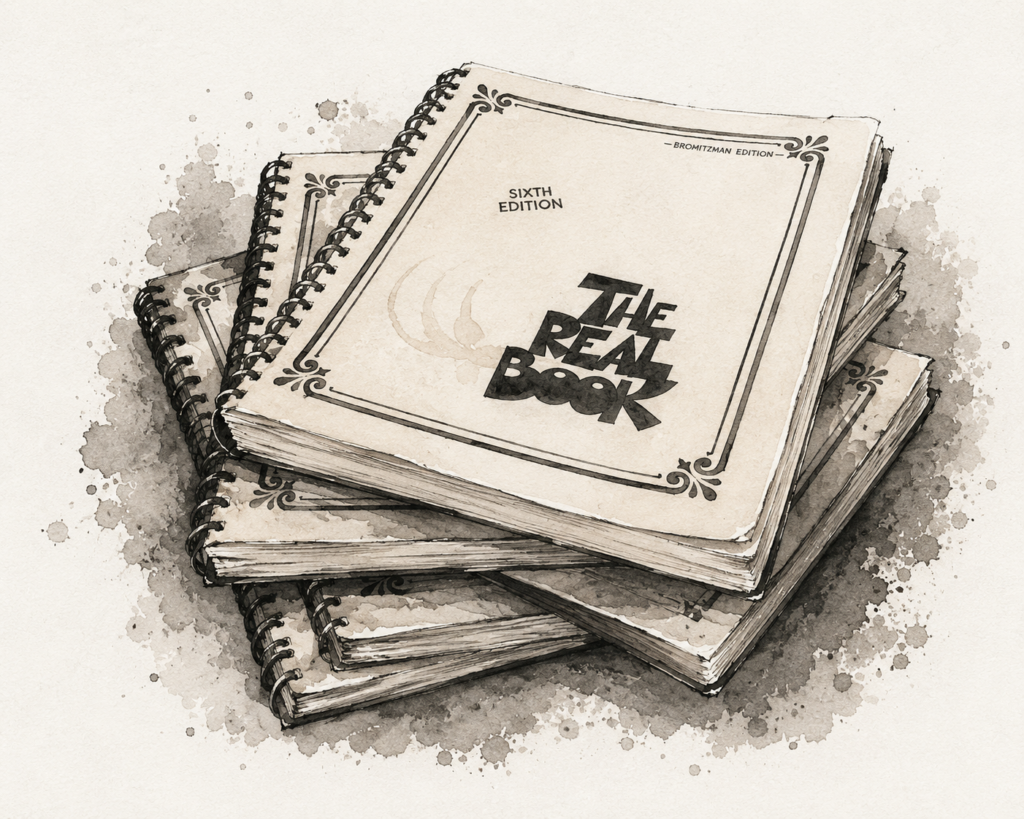
What Is a Fake Book?
Fake books are large compilations of the tunes that musicians most commonly need to know to meet the demands of their audience. Though many variations have evolved, a fake book typically includes the melody and chord changes for the tune. The melody line is typically shown as notes on a music staff. Chords are typically notated by name, such as “Cmaj7”, and not as written notes on a staff. In modern sheet music, this format is often referred to as a lead sheet, making a fake book essentially a large collection of lead sheets bound together.
The popularity of fake books stems from their extensive repertoire, enabling musicians to play together even when some or all of them do not already know a particular song. This also allows musicians to “fake it”, meaning to be able to play an unfamiliar song, thus leading to the name “fake books.”
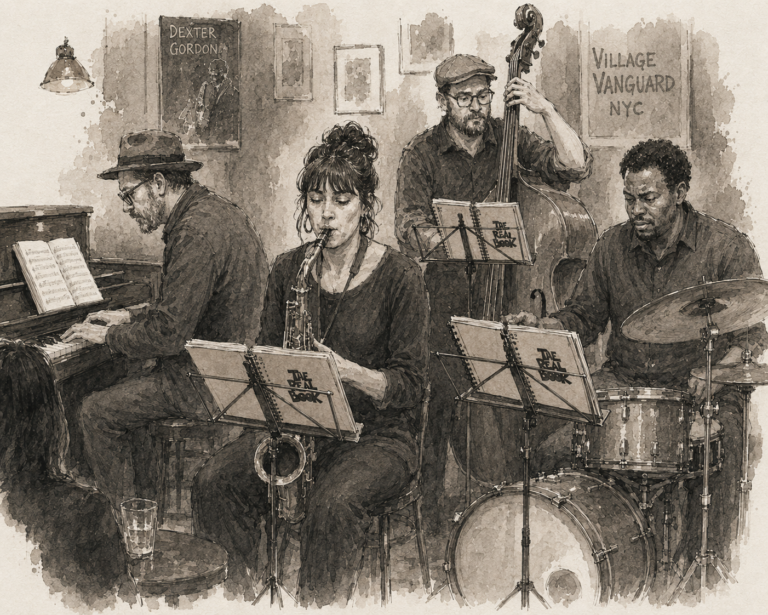
What Is The Real Book?
The lineage of fake books goes back to the bootleg song sheets of the 1930s and the Tune-Dex song reference cards of the 1940s. Bootleg versions were illegal because the publishers did not obtain the legally required copyrights to publish the music. The most popular bootleg fake books originated at Berklee College of Music in Boston. During the 1974-75 school year, two students created a bootleg fake book they called “The Real Book”, because they tried to notate the authentic chord changes and melodic lines that professional jazz musicians would really play. This was in response to the simplified and un-hip changes shown in commercial fake books up to that time.
With its 400 tunes, which gave musicians a more hip, contemporary repertoire, The Real Book was an immense underground success. The problem was that the books were illegally produced and distributed, without regard to copyright law or royalties owed to the composers of the musical masterpieces. In those pre-Internet days, the Real Book was distributed illegally from musician to musician, typically out of someone’s car trunk, or if in the “right” music store the staff thought you were “OK”, a Real Book might appear from under the counter. This practice continues to some extent today, but the music industry is addressing it from two directions.
One is through a much more vigorous enforcement of the Copyright Act against illegal books and websites.
The second is by making the legal version of The Real Book available. Looking back at the history of jazz Real Book editions, this shift transformed the way musicians access charts. Today, the official Hal Leonard Real Book is our top seller because it keeps the iconic handwritten aesthetic while paying composers their due.
We are pleased to offer our customers the first legitimate, legal editions of these books, now published by Hal Leonard. You won’t even notice the difference, except that all the notorious errors have been fixed: the covers and typeface look the same, the song list is nearly identical, and the price of our edition is even lower than the original! Every conscientious musician will appreciate that these books are now produced accurately and ethically, benefitting the songwriters that we owe for some of the greatest tunes of all time!
Understanding Transposing Fake Books: C, Bb, Eb & Bass Editions
Many musicians are unaware that different musical instruments use different staff notes to indicate the same pitch because of transposition. A transposing instrument is a musical instrument for which written notes are read at a pitch different from concert pitch, which a non-transposing instrument, such as a piano, would play. On a transposing instrument, a concert C is written as a different note; the concert pitch that is played for a written C determines the key that an instrument transposes in. For example, a Bb clarinetist playing a written C would sound a concert Bb. Likewise, an Eb saxophonist playing a written C would sound a concert Eb.
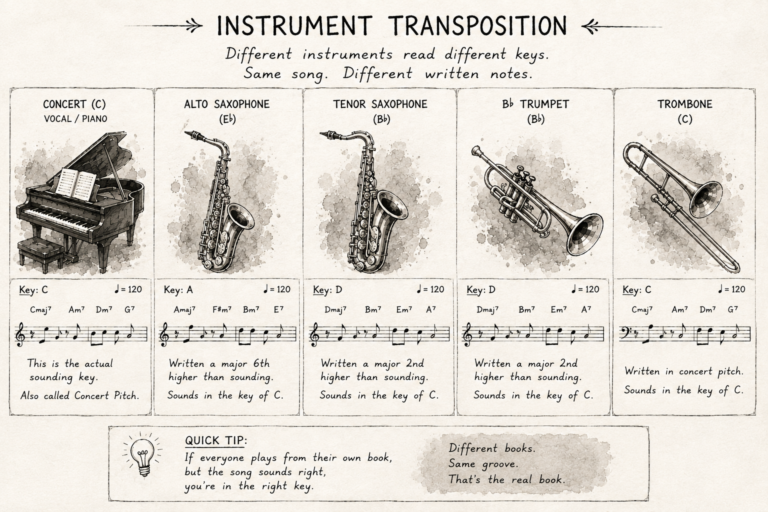
There are several reasons for these transpositions. Many instruments belong to instrument families that differ mainly in size, such as the saxophone, clarinet, and flute. The instruments in these families have differing ranges, with the members sounding lower as they get larger. It is desirable for all members of the same instrument family to have the same fingerings, so that a player can play any member of the family using the same fingerings. As a result, these instruments are transposed based on their range such that each written note is fingered the same way on each instrument.
Instruments that transpose this way are often referred to as being in a certain “key”, such as the A clarinet (clarinet in A), or the F horn (horn in F). The instrument’s key tells which pitch will sound when the player plays a note written as “C”. A player of a B♭ clarinet who reads a written C will sound a B♭, while the player of an F horn will read the same note and sound an F.
Fake books come in different editions or keys to suit the particular instrument being played. When choosing among transposing fake books (Bb, Eb, C), standard C concert editions are typically used for piano, guitar, violin, flute and other “C” instruments. Many horn and woodwind instruments come in C, Bb, Eb and other keys. When a group of musicians plays together from fake books, their music will sound correct if each musician uses a fake book in the key that fits their instrument.
How to play from a fake book
Learning how to play from a fake book and understanding how to read a lead sheet could literally fill a book. In fact, it has! We carry an excellent book, How To Play From A Fake Book, that covers the topic in detail. However, in this primer, we will cover a few basic ideas for using a fake book.
For non-chord instruments, such as horns and woodwinds, the focus will be on playing the melody from the fake book, followed by improvised fills or choruses based on the chord changes. The musician will want to use the fake book to practice and learn the melody line, and then get to know the chord changes. Techniques for learning chord changes include starting by playing the root of each chord, then practicing the root, third, and fifth of each chord, and finally practicing the scale associated with each chord. This will help with learning the chord progression and assist with improvising.
Chord instruments, such as the piano and guitar, will also use a fake book to learn how to accompany melody-playing instruments. This may include learning to play the chords and variations, and developing different rhythm and strumming patterns to keep the accompaniment fresh and interesting. Beyond accompaniment, these instruments can also play both chords and melody. This is done by playing chords with the melody note as the top note, and by mixing chords with individual melody notes.
All of these skills require practice and repetition, but with effort, any musician can become more proficient at playing from a fake book with other musicians or solo.
1 thought on “Fake Books 101: What is a Fake Book & How to Use The Real Book”