When I look back on my guitar-playing “career” of nearly 40 years (I started very young), I can divide the time into two major periods. The first, lasting 30 years, was before I learned to practice; the second, for the last 10 years, was after I learned to practice. Yes, it took me 30 years to learn how to practice.
It never even occurred to me that I might need to learn how to practice. I had taken lessons with several teachers over the years, and none had ever mentioned anything about how to practice, just that I needed to do it. I’m stunned by this realization, and yet it is true. Had I learned how to practice a musical instrument effectively earlier, I would have improved my playing immensely and made much faster progress.
Even more tragic is that nearly every music student I meet, adults and children alike, including those attending weekly lessons with a teacher, lacks a shared understanding of how to practice.
And the biggest tragedy of them all is that learning how to practice takes about 10 minutes. I suspect that the lack of guidance on how to practice causes many would-be musicians to quit early on and to believe they lack talent or ability, all due to a missing 10-minute lesson on effective instrument practice techniques.
Why Traditional Music Practice Fails Beginners
Here’s how most beginner music students practice before learning how to do it right. The teacher has given them an assignment – in this beginner example, it’s an eight-bar song with four notes per measure, for a total of 32 notes in the piece.
They sit down to practice by playing the piece and it goes something like this:
… OK, get in position for the first note … play the first note
… now a bit of a delay while remembering where the second note is … get that fingered … play it ….
OK, what’s the third note? … oh, yeah, ooh that’s a hard one … OK let’s try it … ugh, that didn’t sound too good, try it again … ugh, another clam, I don’t know if I’ll ever be able to play that note, OK keep going …
fourth note is where? … OK, geez that’s a stretch … ouch … reach, reach … got it … play it, …
where’s the next one? … and so on.
After grinding through the 32 notes in about 3 minutes of stumbling, they’re finally done.
The piece would sound like music if played in about 20 seconds; however, at the 3-minute rate, what they got didn’t sound like music, and their fingers or other body parts hurt, and they’re wondering how much longer and how many times more they need to grind through the piece to get better.
Does this sound familiar to you, or to your child?
This method of practice just convinces the student how hard it is to play, and how little fun it is to practice. Combine this with a slow rate of improvement, some self-doubt, maybe a desire to go play outside, or thoughts about maybe starting too late in life, and it’s easy to see why quitting becomes a real possibility. All this because a practice method is being used that doesn’t address the central challenge when learning how to play guitar, piano, or any musical instrument – muscle memory.
Developing Muscle Memory for Music Performance
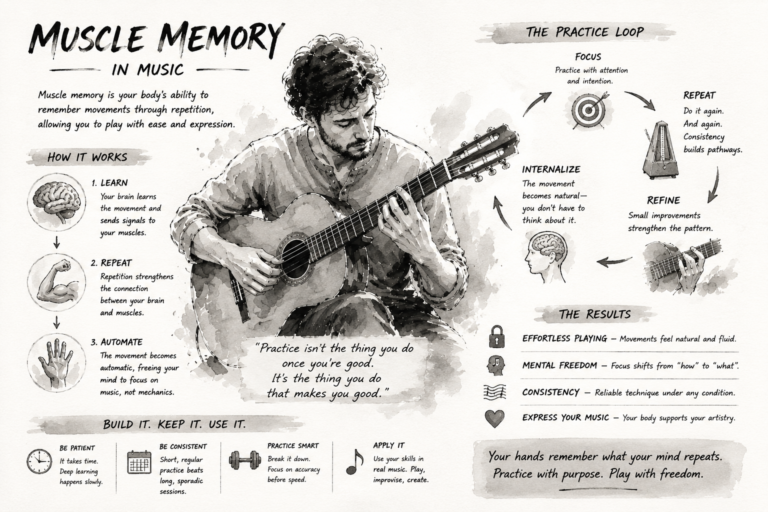
You’ve probably heard the term “muscle memory” but may not know that it’s a term used by muscle physiologists to describe activities that are learned and become automatic. Basically, all of your muscles learn how to work together, with the right timing, pressure, and speed to do whatever you have “memorized” through repetition. And once the memorization is complete, the muscles not only know “how” to do something but also do it automatically. This is the essential building block of developing muscle memory for music – the playing without thinking – whether it’s a single note, a complex chord, or a fast scale.
Now let’s go back and look at our practice session.
When we grind through the piece, with lengthy gaps and repeated errors between notes, we’re not only making it hard; we’re also preventing any useful muscle memory development.
Muscles need rhythmic repetition for the best memory gains. And without that, most of our practice effort is wasted.
So what’s the right way? Let’s go back to the piece our teacher gave us.
The 2-Note Micro-Chunking Method: How to Practice Effectively
This time we’re going to just practice the first two notes, first slowly, then faster and faster, until we can play just those two notes well and at a musical speed.
How to Help Your Child Practice Music Without Frustration
For example, if we’re practicing one of the classic songs of beginner music, “Lightly Row,” we’re just going to play the two notes for “light-ly” over and over.
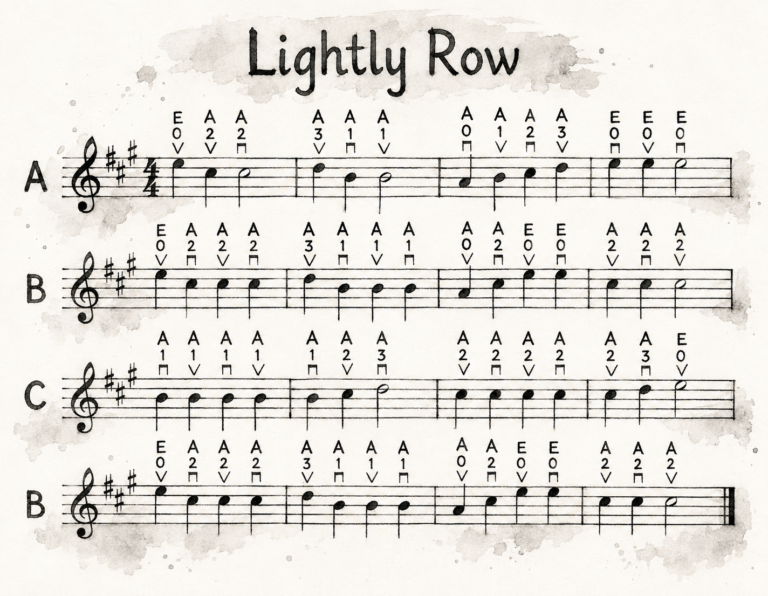
I encourage the student or their helper to sing along and sing the unplayed beats, so it sounds like “light – ly – three – four, light – ly – three – four, light – ly – three – four …” with the student only playing the first two beats.
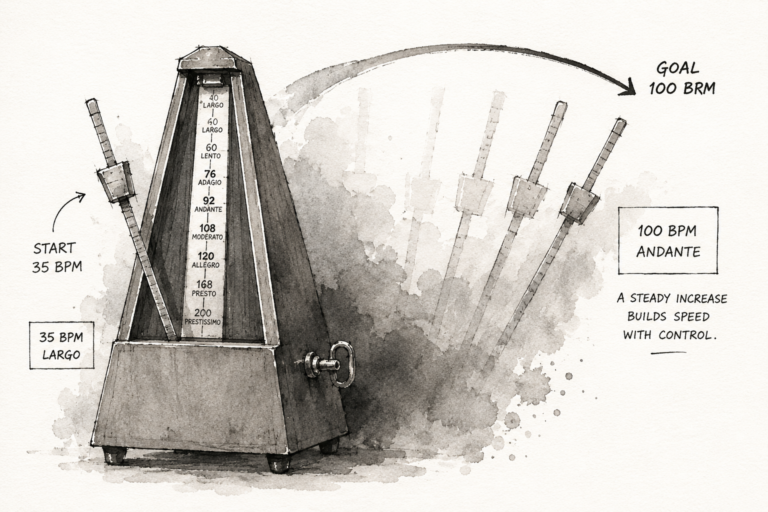
We may have to start very slowly (35 beats per minute (BPM) on a metronome) to get these notes at first, but once we can play them cleanly, we follow a structured metronome practice routine for beginners, increasing tempo in small increments (or pencil tapping, or whatever) in small increments, like 5 BPM per increase, so 35, 40, 45, etc.
📌 Portfolio Strategy Note: Mid-article contextual lead capture designed to convert high-intent organic search traffic into email subscribers.
Free Practice Tracker PDF
Stop guessing what to practice. Download our free Printable Practice Log & Tempo Tracker to track your BPM gains week over week.
Download Free Practice Sheet →What’s not obvious about practicing your instrument correctly
It may not be obvious what’s happening here, but for the brief moments you are playing those two notes, correctly and in time and rhythm, you ARE making music! You probably started learning an instrument because you wanted to play music, and you just did, albeit for just a second. But if you can do it for a second, then you can do it for two seconds, and three seconds, and so on. So, if you practice music correctly, you can be playing during your very first practice session. Compare the mental lightness of this immediate success with the mental load of traditional thinking, which is something like “practice for 5 years, and then you’ll be able to play music.” Which do you think will motivate you better to return to the practice stand?
With each increase in speed, we ensure that the notes are still played correctly and in proper time. With my 7-year-old daughter on the piano, we’ll keep raising the tempo (I tap) until it’s so fast I can’t sing any faster and she falls off the piano bench laughing. That’s what we want – fun, speed and muscle memory, in an exercise that took a few minutes.
Then we add the third note – back to 35 BPM “light – ly – row – four, light – ly – row – four …”. Use the same drill: start slow, bring the speed up, then go fast. Then we add the fourth note. At this point the student is playing a full measure of music as music – there’s a beat, there’s a clear melody, there’s singing and fun, and the muscles are soaking it all in.
By the time we’ve gotten through a full measure (four notes), maybe 15 minutes have gone by, and it’s a good time to stop. I find that muscle memory is enhanced by some intensity (playing as fast as you can while still keeping good time) followed by a pause. The pause could be for 30 minutes if the student is anxious to do more, to a few hours, to the next day. Whatever works for the situation is fine.
When the next practice session begins, repeat the process for 2, 3, and 4 notes if needed, or just start adding the fifth note if the student is ready. The key is to always use the same drill – first slowly, then faster.
Applying Effective Practice Techniques to Advanced Pieces & Specific Instruments
Does this method work for more advanced players? Definitely. More advanced players may not need to go as slow as 35 BPM, or you may need to go even slower.
Whatever initial speed allows you to play those first two notes well is fine, whether it’s 20 BPM or 80 BPM.
You may be practicing something far more complex than a single-note “Lightly Row” song, but you’ll still use the same approach:
- If you are tackling fast sixteenth-note runs, practice those and add the next when ready.
- If you can play most of a piece very well, but there’s one stumbling point, then just use the practice technique at the stumbling point.
- If you’re playing a multi-note piano chord or complex guitar passage, or something that is complex due to the coordination of two hands, you can break down the first two notes and just start with the left hand (on a piano) until that’s mastered and then add the right hand.
- For classical or acoustic guitarists learning fingerpicking who don’t believe they can coordinate the movement of individual fingers on both hands at the same time, this method will show them otherwise. Just practice finger-picking the first two notes and forget about why it works – it just works.
Whatever you need to do to get the first two notes played slowly and well is your starting point.
Thank you for your article. I am 48 and only just starting to learn the guitar. At my age one has a lot of doubts and apprehensions about learning a new skill. I found your technique to be really useful.
Hi,
I agree completely with your approach of using small note groups as building blocks which, when perfected, can be added to more note groups.
I teach violin and viola, and tell my students that my goal as a teacher is for them to get to the point where they don’t need me anymore. When I get new students, they ask me how much to practice and what I tell them is when they are practicing, they should “give themselves a lesson.” In other words, think like a teacher. They can get alot more accomplished in much less time with that approach.
Thanks for taking the time to write about these sometimes personal issues for musicians. I look forward to reading more, and will pass along some of your articles.
Well said, sir! Learning how to practice is an essential skill for any growing musician. Learning how to play an instrument is a wonderful experience for anyone. I play bassoon, bass, and autoharp… but mostly I love to sing.
My son has just started in the school band on trombone. At this point, he is grappling with all the fundamentals of learning how to read music and make the right sounds at the right time. It can be frustrating.
I have explained to him that what he is really doing as a new player is ‘learning how to learn’. Also, he is doing more than just learning how to blow a trombone – he is learning about music.
The best music teachers help their students become musicians – not just manipulators of a particular instrument, but careful listeners and observers.
Nice blog – I learned of it through your posts in Chordie.com.